Pilates and strength training: how to fit both into one week
Yes, you can do Pilates and strength training in the same week, even on the same day. Sample weeks for two, three or four classes, and how to add strength at home.

Yes, you can do Pilates and strength training in the same week, even on the same day. A practical week is two or three Pilates classes plus two strength sessions, which matches the World Health Organization's call for muscle-strengthening work at least twice a week. On a double day, do the session that matters more first.
Key facts
- World Health Organization guidance for adults (2020): work all the major muscle groups against resistance at least twice a week.
- ACSM's survey of fitness professionals for 2027, released October 20, 2026, puts "balance, flow and core strength", the group Pilates belongs to, in third place; a year earlier it was fifth.
- Two or three Pilates classes a week is a common starting point; add strength on days without a demanding class.
- A common rule of thumb: leave about 48 hours between hard sessions for the same muscles.
Can you do Pilates and strength training in the same week?
Yes, and they work well together because they train different things. Pilates builds control, core endurance, mobility and the kind of precise, slow strength that shows up in a clean roll-up or a steady side plank. Strength training lets you add load in small steps, week after week: a little more weight on a squat, one more rep on a row.
Strength work can show up in class too: a stronger back of the body can make bridging and leg work feel steadier, and stronger shoulders and upper back can help with planks and push-ups on the reformer. Pilates, in turn, gives you the body awareness to lift with better positions.
The only real conflict is fatigue. If you squat heavy on Monday morning and then take a leg-heavy reformer class that evening, both sessions suffer. A little planning fixes that.
How often should you do Pilates?
Two or three classes a week is a common starting point for new students. It gives you enough practice to learn the movements while leaving room for rest and for other training.
- Two classes a week suits beginners and anyone adding two strength sessions.
- Three classes a week suits students who have the basics and want steady progress.
- Four or more works if some sessions are lighter, such as a stretch-focused mat class, and you sleep and eat well.
Daily Pilates is possible, especially gentle mat work, but more classes aren't automatically better. Consistency over months matters more than any single week.
Is Pilates enough strength training on its own?
It depends on your goal. Pilates challenges your muscles with springs, body weight and time under tension, and for general strength and control it covers a lot. If you want to lift heavier things, build more muscle or simply keep adding load as you get stronger, adding a couple of weight sessions helps, because you can increase the weight in small steps.
A useful way to think about it: Pilates teaches your body to move well, and strength training gives it more to move with.
Sample weeks for two, three or four Pilates classes
Keep the hardest strength work away from the day before your most demanding class, and give the same muscles about 48 hours between hard sessions.
| Pilates classes a week | Strength sessions | A sample week |
|---|---|---|
| 2 | 2 | Mon Pilates, Tue strength (lower body), Thu Pilates, Fri strength (upper body), Sat a long walk |
| 3 | 2 | Mon Pilates, Tue strength A, Wed Pilates, Fri Pilates, Sat strength B |
| 4 | 1 to 2 | Mon Pilates, Tue Pilates, Wed full-body strength, Fri Pilates, Sat Pilates, Sun a short circuit if you feel fresh |
Swap the days to fit your studio's timetable; the pattern matters more than the exact days.
Can you do Pilates and strength training on the same day?
Yes. Two simple rules keep both sessions useful:
- Put first what matters more to you. If you're working toward a heavier deadlift, lift first. If the reformer class is your priority, take the class first and do lighter strength work afterward.
- Split them if you can. A morning lift and an evening class, a few hours apart, feels much better than one straight after the other.
On a same-day split, pair upper-body strength with a leg-heavy class, or lower-body strength with a class that focuses on the core and arms.
What does a home strength session between classes look like?
You don't need a gym. A pair of dumbbells or a resistance band and 30 minutes are enough for a full-body session:
- Squat: goblet squats or split squats.
- Hinge: Romanian deadlifts or glute bridges.
- Push: push-ups, on a bench or the floor.
- Pull: one-arm rows or band rows.
- Carry or core: suitcase carries or dead bugs.
Two or three sets of 8 to 12 controlled reps per exercise is a sensible start. When the last two reps of a set feel easy, add a little weight or a rep. On a busy day, run the same moves as a timed circuit: 40 seconds of work, 20 seconds of rest, three rounds.
Where does an AI workout plan fit?
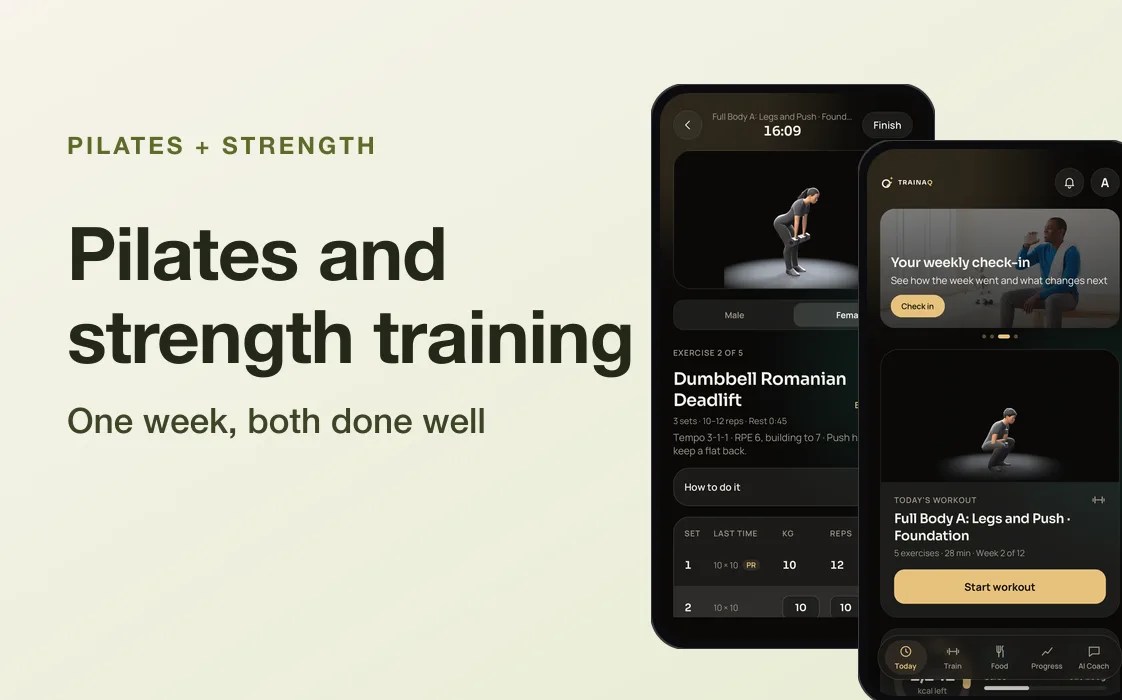
Working out what to do on strength days, and when to add weight, is where an AI plan helps. Trainaq AI Coach asks where you train, what equipment you have and how many days you can give it, then builds your workouts in about 2 minutes. Each exercise has a 3D demo, timed workouts and circuits run on a timer, and every Monday it sums up your week. On Premium, the AI coach adjusts next week's workouts from how it went.
It doesn't plan your Pilates; your instructor does that, and your classes stay in your studio's app. See how it fits on our AI workout and diet plan page. Trainaq AI Coach is from MyGymDesk Technologies, the team behind StudioFly.
Questions students ask
Should I do Pilates or strength training first?
Do first whichever session matters more to you that day. If you're chasing a strength goal, lift first while you're fresh. If the class is the priority, take it first and keep the strength work lighter.
Is it OK to do Pilates every day?
Gentle mat Pilates every day is fine for many people, but harder reformer classes need recovery like any other training. Two or three classes a week, plus rest days, is a good base for most students.
Do I need weights at home to strength train?
No. Body weight, a resistance band or a pair of dumbbells is enough to start. Weights make it easier to keep adding load in small steps as you get stronger.
Can I do a reformer class the day after leg day?
You can, but you may feel heavy and less precise. If your reformer class is demanding, move hard leg work earlier in the week or keep it lighter the day before.
Sources
- World Health Organization, WHO guidelines on physical activity and sedentary behaviour, November 25, 2020.
- American College of Sports Medicine, 2027 ACSM Worldwide Fitness Trends, October 20, 2026, and Top fitness trends for 2026, 2025.