Yoga diet plan: what to eat around your classes
A yoga diet plan doesn't need special foods. What to eat before and after class, how much protein you need, a sample vegetarian Indian day and Jain swaps.

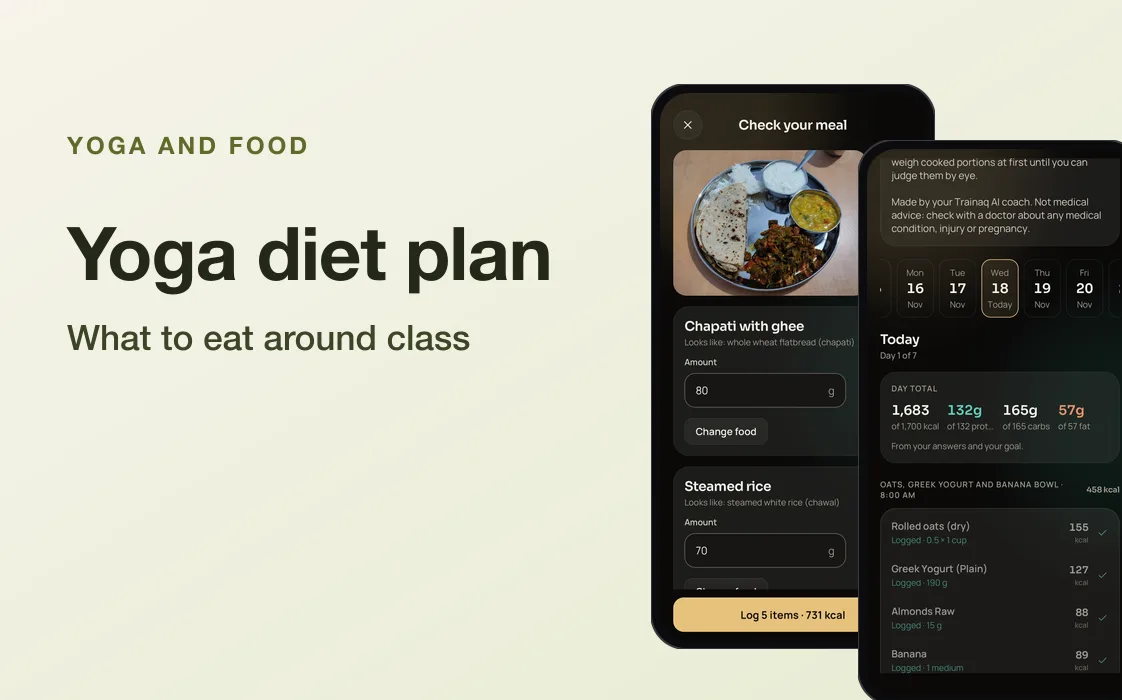
A yoga diet plan doesn't need special foods. Practise on an empty or light stomach, as the Ministry of AYUSH's Common Yoga Protocol advises, eat enough protein across the day and build meals around dal, grains, vegetables, curd and fruit. Then size the plan to your goal and your class times, not to a fixed chart.
Key facts
- The Common Yoga Protocol (Ministry of AYUSH) says to practise on an empty or light stomach, and suggests a little honey in lukewarm water if you feel weak before practice.
- ICMR-NIN's recommended protein intake for healthy Indian adults is 0.83 g per kg of body weight a day: about 54 g for someone who weighs 65 kg (Nutrient Requirements for Indians, 2020).
- The World Health Organization's 2020 guidance asks adults to work their muscles against resistance at least twice a week, which many yoga students do alongside classes.
What is a yoga diet?
People mean two things by it. The first is the traditional yogic, or sattvic, diet: fresh, simple, mostly vegetarian food, eaten in moderation. The second is practical: what to eat, and when, so that classes feel good and your body gets what it needs.
You don't need to follow a traditional diet to practise yoga. This guide is about the practical side: timing, protein and an ordinary Indian day of eating that fits around classes.
What should you eat before yoga?
Very little, close to class. Twists, forward folds and inversions are uncomfortable on a full stomach, which is why the Common Yoga Protocol asks for an empty or light stomach.
- Morning class: water on waking is often enough. If you feel weak, the protocol's suggestion is a little honey in lukewarm water; a few soaked almonds or half a banana also sits lightly for many people.
- Evening class: keep lunch at its usual time, and if you're hungry closer to class, have something small about an hour before, such as fruit, a glass of buttermilk or a handful of roasted chana.
- After a full meal: a common rule of thumb is to wait two to three hours before a dynamic class.
Notice what works for you. Some students prefer nothing at all before a 6 am class; others feel dizzy without a small snack.
What should you eat after yoga?
A normal meal. There's no special post-yoga food: eat your next meal within a couple of hours and include a source of protein. After a morning class that might be poha with peanuts and a bowl of curd, or a besan chilla. After an evening class, dinner as usual.
How much protein does a yoga practitioner need?
ICMR-NIN's recommended intake for healthy Indian adults is 0.83 g of protein per kg of body weight a day. For a 65 kg adult that's about 54 g a day, spread across meals.
Vegetarian sources make this straightforward when every meal has one:
- Pulses: dal, rajma, chana, moong and sprouts.
- Dairy: curd, paneer, milk and buttermilk.
- Soya: soya chunks and tofu.
- Nuts and seeds: peanuts, almonds and seeds, in small amounts.
- Eggs, if you eat them.
If you also strength train, the simplest step is a protein source at every meal rather than a bigger one at dinner.
A sample vegetarian Indian day for a morning yoga class
This is an example, not a prescription. Portions depend on your size, your goal and how active you are.
| Time | What to eat |
|---|---|
| On waking | Water, or a little honey in lukewarm water if you feel weak |
| 6:30 to 7:30 am | Yoga class |
| 8:30 am | Poha with peanuts and vegetables, a bowl of curd |
| 11:00 am | A piece of fruit |
| 1:30 pm | Two rotis or rice, dal, a vegetable sabzi, salad, curd |
| 5:00 pm | Buttermilk and a handful of roasted chana |
| 8:30 pm | Rotis, paneer or tofu bhurji, a vegetable, and dal if you like |
For an evening class, move the 5 pm snack to about an hour before class, keep it small, and have dinner afterwards.
Jain swaps: skip onion, garlic and root vegetables; use moong dal, paneer, curd and vegetables such as bottle gourd, beans and capsicum.
Eggetarian swaps: add eggs at breakfast, such as a vegetable omelette instead of poha.
Should yoga practitioners add strength training?
Many do, and the two fit together. Yoga builds mobility, balance and control; strength training with weights or bands lets you add load in small steps, and the WHO's guidance points the same way, asking for resistance work at least twice a week. A simple week is yoga on Monday, Wednesday and Friday, with two 30-minute strength sessions on Tuesday and Saturday.
If you take Pilates too, our guide to Pilates and strength training has sample weeks you can borrow.
How can an AI diet plan help?
The hard part of any diet plan is turning a target into meals you actually eat. Trainaq AI Coach asks how you eat, vegetarian, eggetarian, Jain or non-vegetarian, and sets a daily calorie and protein target to match your goal in about 2 minutes. You log Indian and global foods in katori, cups and slices, or take one photo of your plate and check what the AI reads. Every Monday it sums up your week, and Premium plans a week of meals around your target.
Its advice is about training and food, not medicine, and it doesn't plan your yoga; your teacher does. See what it includes on our AI workout and diet plan page. Trainaq AI Coach is from MyGymDesk Technologies, the team behind StudioFly.
Questions yoga students ask
Is it bad to eat before yoga?
A full meal right before class makes twists, folds and inversions uncomfortable. Practise on an empty or light stomach, and if you feel weak, take something small, such as a little honey in lukewarm water.
Do I need to be vegetarian to do yoga?
No. The traditional yogic diet is vegetarian, but you can practise yoga whatever you eat. What matters for class is timing and enough protein across the day.
Is a yogic diet the same as a sattvic diet?
They're usually used to mean the same thing: fresh, simple, mostly vegetarian food eaten in moderation, as described in traditional yoga texts.
Can a yoga diet plan help me lose weight?
Weight change depends on your overall eating and activity over time, not on any yoga-specific food. A plan with calorie and protein targets that suit your goal is the practical starting point. If you're pregnant or managing a health condition, check with your doctor before changing how you eat.
Sources
- Ministry of AYUSH, Common Yoga Protocol, 4th revised edition, May 2019.
- ICMR-National Institute of Nutrition, Nutrient Requirements for Indians: a brief note, 2020, and Dietary Guidelines for Indians, 2024.
- World Health Organization, WHO guidelines on physical activity and sedentary behaviour, 25 November 2020.