Private Pilates Sessions: How to Price and Package Them
Set the right price for private Pilates sessions by anchoring to your group class revenue, then package them smartly to keep clients coming back.

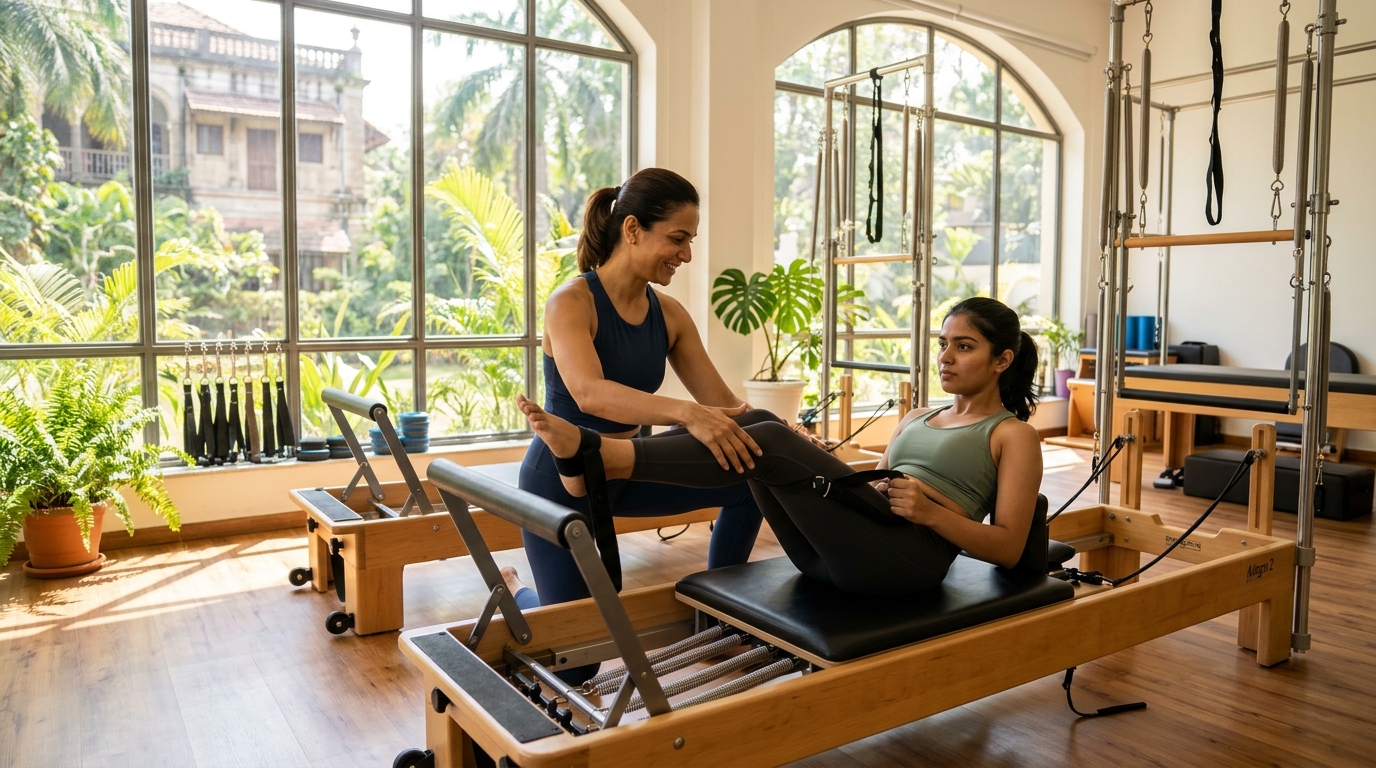
Price a private Pilates session by working out what that same hour earns you as a group reformer class, then setting the private rate high enough to compensate for the lost group revenue and the extra instructor attention. A private session fills one reformer with one fee, so the number must hold its own against a full group. Everything below shows you exactly how to do that arithmetic, who to offer privates to, how to structure duo sessions and packages, and how to pay your instructors fairly.
This post also covers when to schedule privates, and how to move private clients into group classes once they are ready — which is where your real volume and retention come from.
What is the right starting point for pricing private Pilates sessions?
Your group reformer class is the anchor. According to StudioFly's research across 42 studios in six Indian cities (211 published prices, checked 24 September 2026), the median drop-in price for a reformer Pilates class is ₹1,649, and the median per-class price in the smallest reformer pack is ₹1,200.
When you teach a group class of, say, six clients, the studio collects six times the per-class rate. A private fills that same slot with one fee. Your private session price needs to reflect at least a meaningful share of what you would have earned from a full group — and it must also carry a premium for the undivided instructor time and the individualised programming that the client receives.
A common approach: look at your average group class revenue per slot (number of paying clients × your pack rate), and set your private rate somewhere between half and the full value of that figure. The exact multiple is yours to decide based on your city, your clientele and your instructor's level. The key discipline is to do the maths before you name a number, not after.
Who actually benefits from a private Pilates session?
Privates are not for everyone, and they should not be sold to everyone. These are the client profiles where a private session genuinely makes sense.
Beginners who have never done Pilates. A new client on a reformer without prior movement experience benefits from one or two private sessions before entering a group class. They learn the vocabulary, the spring settings and the basic positions at their own pace, without slowing the group down or risking poor form.
Clients returning after an injury. Once a client's doctor or physiotherapist has cleared them to return to exercise, a private session lets the instructor understand what range of motion the client has, what loads are appropriate and what movements to avoid — before they re-enter the group environment. Present this clearly: Pilates is a movement practice, not a medical treatment. Always ask for clearance from the client's healthcare professional before they begin.
Clients preparing for a specific group class. A client who wants to join your intermediate reformer group but lacks the baseline strength for it can use a package of privates to build up. This creates a natural upgrade path: private → group.
Long-standing clients who want focused work. Some experienced clients book a private session once a month to work on something specific — a particular movement pattern, an athletic goal — alongside their regular group attendance.
How should you structure duo Pilates sessions?
A duo session places two clients on reformers (or one on a reformer and one on a mat) with one instructor. It is priced below a private but above a group drop-in, and both clients pay their individual rate. The studio collects two fees for one instructor's time, which improves the economics significantly.
Duo sessions work well for:
- Two friends or partners who want to train together
- A returning client who brings a newer friend as a bridge to group classes
- A client who cannot afford solo privates regularly but values more attention than a group class provides
A few things to get right before you offer duos:
- Same level, ideally. Pairing a beginner with an advanced client puts the instructor in an impossible position. Keep levels matched.
- Fixed pairs. Treat the two clients as a unit for booking and billing. If one cancels late, your cancellation policy (see late-cancellation and no-show policies for studios) should address whether the remaining client can keep the slot as a solo or reschedules.
- Clear pricing per person. State on your website and intake that the duo rate is per person, not for the slot. This avoids confusion when payment is collected.
How do you build private Pilates session packages?
Single-session pricing discourages commitment. Packages of several sessions with a fixed validity are better for the client (they commit to making progress) and better for you (you recognise revenue over a defined period and reduce the chance of clients drifting away).
A practical package structure to consider:
| Package | Sessions | Validity | Purpose |
|---|---|---|---|
| Starter | 3 sessions | 4 weeks | Onboarding for new clients |
| Foundation | 6 sessions | 8 weeks | Injury return or technique focus |
| Intensive | 10 sessions | 12 weeks | Deep skill-building before group |
(Session counts, validity and prices are illustrative. Set your own based on your cost structure and local market.)
A few principles for designing packages:
- Keep validity tight enough to maintain momentum. A ten-session pack with a year's validity creates no urgency to attend. Eight to twelve weeks for ten sessions is enough time to be flexible but short enough that the client stays engaged.
- Price per session in a larger pack slightly lower than a solo session. The discount rewards commitment; the volume makes up for the lower per-session rate.
- State what happens to unused sessions at expiry. Write this into the package description at the point of sale, not only in the fine print.
- Offer a bridge package explicitly designed to end in group membership. For example, a six-session foundation pack that comes with a discounted first month of group classes if purchased within two weeks of completion. This makes the pipeline from private to group concrete and visible to the client.
How should you pay instructors for private Pilates sessions?
Instructor pay for group classes is typically a per-class flat rate or a small commission on attendance. Private sessions work differently because the instructor takes on extra responsibility: pre-session planning, individualised cueing and sometimes liaison with the client's healthcare provider.
A common approach is a percentage of the private session fee, agreed in advance. Some studios use a flat rate per private session instead. Neither is universally better; what matters is that the rate is:
- High enough that the instructor values and prioritises privates
- Set at a level the studio can sustain after covering overhead for that slot (the reformer, the studio space, software, utilities)
- Agreed in writing before the instructor takes any private bookings
Track commissions session by session, not at the end of the month from memory. When an instructor takes fifteen privates across four weeks, manually calculating who taught what and at what rate is where errors creep in.
When should you schedule private Pilates sessions?
The worst time to run a private is during a slot where a full group class would otherwise have sold out. The best times are:
- Early morning or late evening slots that are hard to fill with groups because the minimum viable headcount is rarely reached
- Midday weekday slots where corporate or freelance clients can attend but group numbers are low
- Slots between group classes that are currently sitting empty
Mapping your timetable against your attendance data will show you which slots consistently underperform for group bookings. Those are your private session windows. Privates in those slots generate revenue that would otherwise not exist, rather than cannibalising group income.
How do you move private clients into group classes?
The goal of most private Pilates packages should be a client who eventually joins a group class — which is where your studio's economics work best. See Is a Pilates studio profitable? The numbers for an Indian studio for more on why group volume matters to margin.
Make the transition easy and explicit:
- Set a milestone at the outset. At the first session, tell the client which group class they are working towards and roughly how many private sessions it typically takes to get there.
- Invite them to observe a group class (not participate) around the halfway point of their package. Familiarity removes the anxiety of joining a room full of strangers.
- Book them into their first group class before their last private session ends. If they leave their private package without a group booking, re-entry friction is high.
- Offer a trial group class as part of the private package itself. One included group class credit, used in the final two weeks of the package, is a low-cost nudge that works.
Clients who make the transition from private to group tend to be your most retained members: they know the studio, they trust the instructor and they have already built a movement habit. That history is worth protecting.
How StudioFly helps
StudioFly's Pilates studio software lets you create one-to-one and duo session packages separately from your group classes, so private clients book directly into their instructor's open slots without touching the group timetable. Commissions are created automatically for every private session the instructor completes — no manual tracking at month end. You can manage group class scheduling, private packages, memberships and billing in one workspace, so the full picture of a client's journey from private sessions into group classes is always visible.
FAQs
How do I price private Pilates sessions if I have no reference point?
Start with your group reformer class revenue per slot — the number of clients in a typical class multiplied by the pack rate they pay — and set your private rate to cover at least what you would have earned from a moderately filled group class. StudioFly's research found the median reformer pack rate is ₹1,200 per class (across six Indian cities, 24 September 2026); use your own actual pack rate as the baseline, not a city median.
Should duo Pilates sessions be priced per person or per slot?
Per person. Each client pays their individual duo rate, and the studio collects two fees for one instructor's hour. Make this explicit in your booking flow and on your pricing page so neither client assumes the other is covering the full slot cost.
How many sessions should a private Pilates package include?
Three to ten sessions, depending on the client's goal. A three-session starter pack suits onboarding; a ten-session pack suits a structured return after a break or an injury (once medically cleared). Keep validity tight — eight to twelve weeks for a ten-session pack maintains momentum.
How do I pay instructors fairly for private Pilates sessions?
Agree a percentage of the session fee or a flat per-session rate before the instructor takes any private bookings, and track it session by session. Private sessions carry more preparation and responsibility than a group class slot, so the rate should reflect that — while remaining sustainable against the studio's per-slot overhead.
When is the best time to offer private Pilates sessions?
Fill your underperforming group slots first: midday weekdays, early-morning or late-evening windows where group headcount rarely reaches your minimum. Placing privates there generates revenue that would otherwise be lost, rather than replacing group income you would have earned anyway.