How to Start a Martial Arts School in India
A step-by-step guide to opening a karate, taekwondo, judo or kung fu school in India — covering style, space, instructors, batches, fees and your first year.

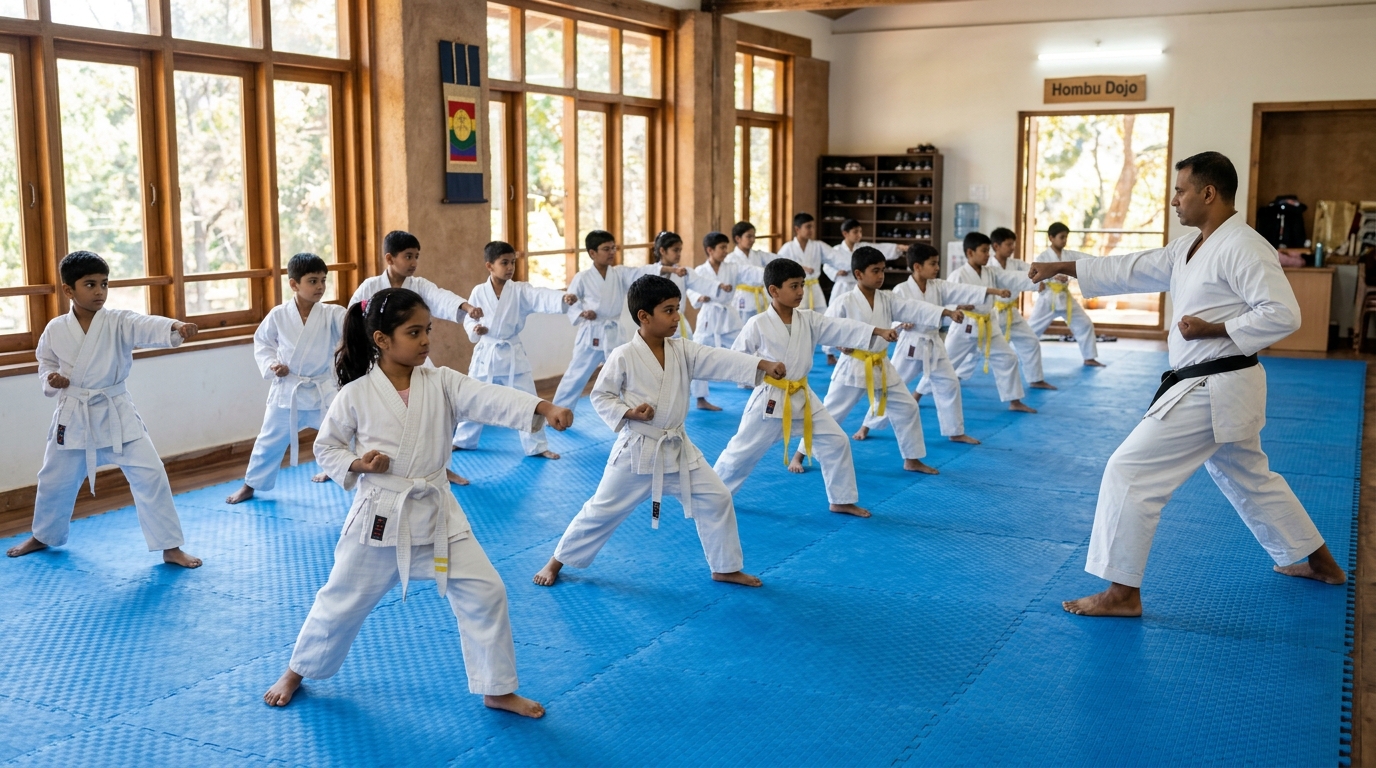
Starting a martial arts school in India is straightforward when you work through five questions in order: which style will you teach, can you prove your credentials and find affiliated instructors, what space and equipment does the style need, how will you structure batches and fees, and what registrations does your local authority require? Answer those questions before you sign a lease or buy a single mat, and the rest of the planning falls into place. This post covers each question in detail, then walks through safety, consent for children's classes, and how to plan student numbers for your first year.
Which style will you teach — and does a federation matter?
Your first decision shapes everything else. Karate, taekwondo, judo and kung fu each have different space needs, equipment costs, instructor pathways and parent expectations.
Karate (Shotokan, Kyokushin, Goju-ryu and others) has the widest student base across India. National bodies such as the Karate Association of India and state-level affiliates run instructor certification and an organised competition calendar.
Taekwondo has a clear international structure through World Taekwondo (WT) and the Taekwondo Federation of India. WT affiliation matters if any of your students want to compete at state or national level.
Judo requires the most mat space per student and places a premium on certified coaching because throws carry injury risk. The Judo Federation of India issues coach licences.
Kung fu and other Chinese martial arts have smaller but loyal student communities. National associations exist, but the landscape is more fragmented.
Why affiliation matters: a recognised federation gives your school legitimacy with parents, opens competition pathways for students and, in some cases, is required before you can use certain style names officially. Check directly with your chosen federation for current membership fees, instructor grades required and annual renewal obligations.
What credentials do your instructors need?
Parents enrolling children want to see that the instructor is qualified, not just experienced. At a minimum, every instructor at your school should hold:
- A grading certificate from a recognised national or state body for the style they teach.
- A coaching or instructor certification from the relevant federation.
- A clean background — a police verification certificate is worth obtaining even where it is not legally mandatory, because many schools now ask for it.
If you are the founding instructor, your own grade and federation membership are your primary credential. If you plan to hire assistant instructors, insist on the same standard from day one. Parents ask, and word travels fast in a locality.
Space, flooring and equipment
How much space do you need to start a martial arts school? A rough working guide: allow at least 100–120 square feet of mat area per student training simultaneously. A single batch of twelve students therefore needs well over a thousand square feet of open floor — before you account for changing areas, a waiting area for parents and storage.
Flooring is the single most important capital item. Interlocking EVA foam mats or judo-style tatami panels are both common. Buy enough to cover the entire training area; partial matting creates an uneven surface and an injury risk. Get a written quotation before you finalise your budget.
Equipment varies by style:
- Karate: focus mitts, kick pads, sparring gear (helmets, gloves, chest guards) for contact classes.
- Taekwondo: kicking targets, hogu (chest protector) and head-gear for sparring; electronic scoring gear is optional for competition training.
- Judo: a thicker mat (at least 40 mm) and nothing else to start.
- Kung fu: wooden dummies and weapon racks come later; start with open space and focus pads.
Lease a space with a ceiling height of at least ten feet — twelve is better for jumping and throwing techniques.
Structuring batches by age and level
A well-structured batch timetable is the operational heart of a martial arts school. Most schools run:
| Batch type | Typical age range | Class length |
|---|---|---|
| Tiny tigers / Little champions | 4–7 years | 30–45 minutes |
| Children's beginner | 8–12 years | 45–60 minutes |
| Children's intermediate / advanced | 8–14 years | 60 minutes |
| Teen and adult beginner | 14 years and up | 60 minutes |
| Teen and adult advanced | 14 years and up | 60–90 minutes |
Keep beginner and advanced students in separate batches. Mixing levels slows down advanced students and overwhelms beginners.
Batch size: a cap of sixteen to twenty students per instructor is a practical upper limit for most striking arts. Judo and grappling styles need a lower cap — twelve to fourteen — because paired drills require more floor space and closer supervision.
Trial classes: offer one or two free trial classes before asking for a fee commitment. A trial lowers the barrier for hesitant parents and gives you a chance to assess whether the child is ready for the group.
Fees: monthly batches and term structures
Martial arts schools in India typically charge in one of two ways:
- Monthly fee: a fixed amount per month, covering a set number of classes per week. This is easy for parents to budget and simple to administer.
- Term fee: a lump sum for a quarter (three months) or half-year, often at a small discount over the monthly rate. Term fees improve your cash flow and reduce the administrative burden of monthly renewals.
Both structures are valid. Many schools combine them — monthly for adults, term-based for children's batches where parents prefer to commit for the academic term.
What to charge: fees vary significantly by city, locality and the school's reputation. Survey two or three established schools in your area, factor in your rent and instructor costs, and set a fee that covers your fixed costs at roughly half of your batch capacity. That is your break-even check. For a broader look at how to price classes and packs, see the guide on class packs vs memberships.
Uniform and equipment fees: charge separately for a gi or dobok. Many schools tie a uniform purchase to enrolment — it creates a sense of belonging and covers your stock cost.
Safety, insurance and parental consent
Safety is non-negotiable, especially in children's classes.
Written consent for children's classes: before any child under eighteen trains, obtain a signed consent form from a parent or guardian. The form should cover:
- Acknowledgement that martial arts involves physical contact and a risk of minor injury.
- Any medical conditions, allergies or physical limitations the instructor should know about.
- Permission for the school to seek emergency medical assistance if needed.
- Contact numbers for the parent and a second emergency contact.
Keep a physical or scanned copy on file for every student. Confirm the exact wording with a lawyer, as requirements can vary by state.
Insurance: a general liability policy that covers sports academies is worth carrying. Some federations offer group insurance for affiliated schools — ask yours. Confirm the coverage details with an insurance broker.
Supervision ratio: in children's classes, a second adult in the room (an assistant instructor or a responsible adult) is good practice when contact drills are involved.
First aid: keep a stocked first-aid kit in the training area. Ensure at least one instructor holds a current first-aid certificate.
Registrations: what do you actually need?
The honest answer is: it depends on your state, your business structure and your turnover. There is no single national licence required to teach martial arts. In practice, you will likely need some combination of the following — confirm each with your local municipal authority and a chartered accountant before you open:
- Business registration: a sole proprietorship requires the least paperwork to start; a private limited company or LLP offers liability separation and is easier to scale.
- Shop and Establishment Act registration: most states require this for any commercial premises where people work.
- GST registration: fitness, health club and yoga services attract 5% GST (SAC 999723) if your aggregate annual turnover exceeds the registration threshold. Your chartered accountant can confirm whether martial arts instruction falls under the same SAC code and what your threshold is. See the full guide on GST invoicing for studios for more detail.
- Local trade licence: your municipal corporation may require a trade or professional licence.
- Fire and safety NOC: if your premises exceed a certain floor area, the local fire department may need to inspect and issue a no-objection certificate.
Do not assume any of these are optional until a chartered accountant or lawyer confirms it for your specific situation.
Planning your first year's student numbers
Example: a single-location school with two batches (illustrative)
| Month | Children's batch (cap: 16) | Adult batch (cap: 14) | Total active students |
|---|---|---|---|
| Month 1 | 8 | 5 | 13 |
| Month 3 | 12 | 8 | 20 |
| Month 6 | 16 | 11 | 27 |
| Month 12 | 16 (waitlist open) | 14 | 30 |
These numbers are illustrative. The point is to plan in steps, not to assume a full school from day one. Build your first batch to capacity before opening a second time slot. A half-full batch still covers your direct costs if your fee structure is right; a half-full batch split across two time slots doubles your instructor hours and halves your revenue per session.
Early-signal metrics to track monthly:
- Trial-class-to-enrolment conversion rate
- Monthly student retention (how many of last month's students renewed)
- Average revenue per active student
If your trial conversion rate is low, the problem is usually the trial class experience or the follow-up. If retention drops after month three, revisit batch structure and communication with parents.
For more on managing enquiries and converting trials, see the guide on how to follow up studio enquiries.
How StudioFly helps
StudioFly's martial arts solution lets you set up each batch as a recurring class with a participant limit, so a children's beginner batch and an adult advanced batch run on separate schedules and never overbook. Attendance is tracked by QR code scan at the door, and WhatsApp reminders go out automatically before fees are due or a renewal lapses — without you having to chase parents manually. Billing handles both monthly and term-based fees, and GST invoices with the correct SAC code and CGST/SGST split are generated for every payment. For a fuller look at software options for academies, see the guide on martial arts academy software in India.
FAQs
How much does it cost to start a martial arts school in India?
The largest variables are rent, flooring and equipment. Flooring for a small training area, a deposit on a commercial space and basic equipment can be quoted from local suppliers before you commit. Write down every cost as a one-time or monthly item, then check whether your projected fees cover monthly costs at roughly half your batch capacity — that is your minimum viable enrolment.
Do I need a federation affiliation to open a martial arts school?
Affiliation is not legally required in most cases, but it strengthens your credibility with parents, gives students a competition pathway and, for styles like taekwondo and judo, connects you to official coaching certification. Contact the national or state body for your chosen style to understand their current membership criteria.
How much do martial arts school owners make in India?
Owner income depends on the number of batches, fees per student, rent and whether the owner teaches or pays instructors. A school with two or three full batches in a mid-tier Indian city can generate a meaningful monthly surplus once fixed costs are covered, but there is no single figure that applies across styles, cities and school sizes. Plan your own numbers: (students × monthly fee) − (rent + instructor costs + consumables) = monthly surplus before your own pay.
What consents do I need for children's martial arts classes?
Obtain a signed written consent from a parent or guardian before any child under eighteen trains. The form should cover physical contact and injury risk, known medical conditions, emergency contact details and permission to seek medical help. Have a lawyer review the template to ensure it meets your state's requirements.
Can I teach more than one martial art at the same school?
Yes. Many academies offer karate and self-defence, or taekwondo and kickboxing, in separate batches. The main considerations are instructor credentials for each style and whether you have enough mat time and floor space to run the additional batches without over-scheduling the space.