What software does a small Pilates studio need?
The must-haves for a Pilates studio with one or two rooms, what can wait, and how to judge pricing so your software bill doesn't grow with every class you fill.
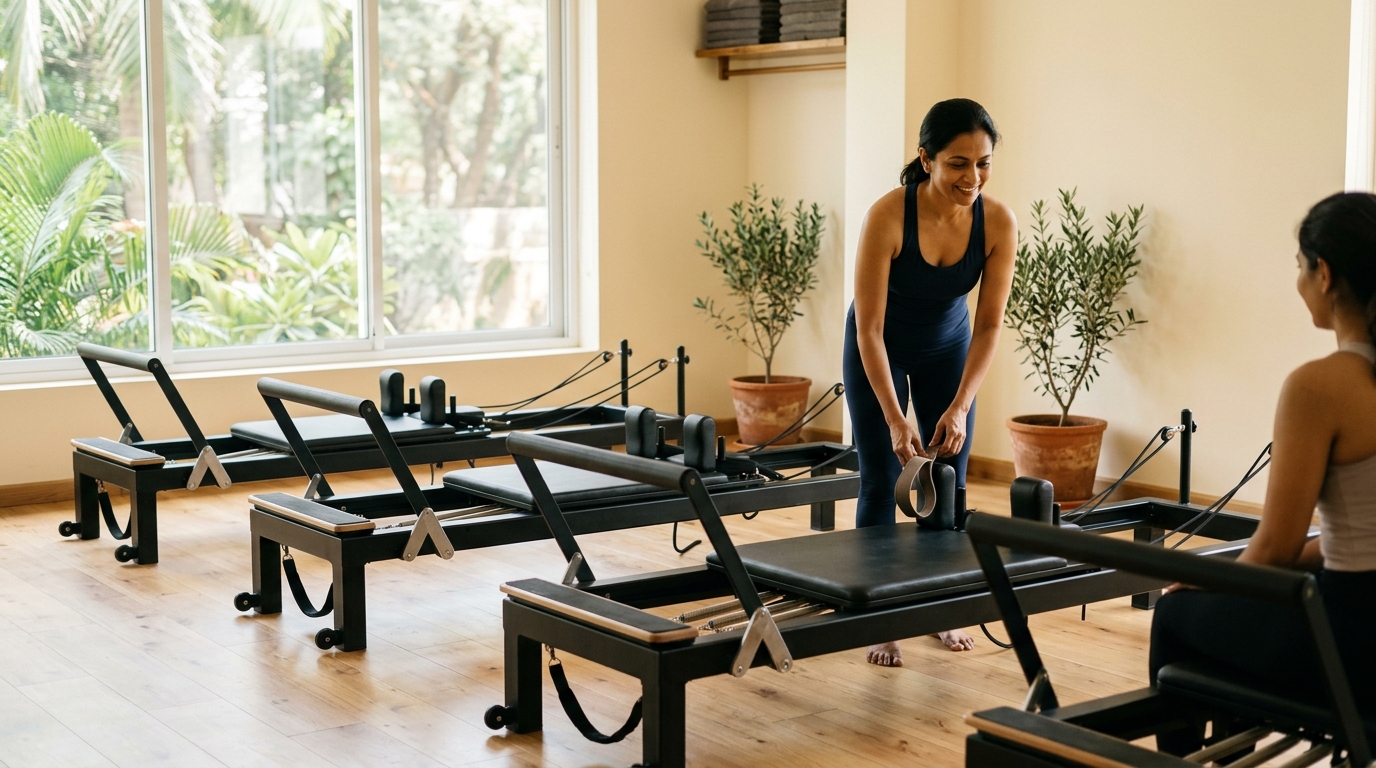
A small Pilates studio needs software that does six jobs well: members book their own spot in a class with a set capacity, a waitlist fills cancelled places, class packs lose a credit when members attend, your cancellation window is applied for you, members pay online by UPI, and confirmations and reminders arrive on WhatsApp. Pay a flat monthly price for that, not a charge on every booking. Most other extras can wait.
The reason is arithmetic. Say your room holds four reformers and you teach five classes a day. That's 20 places a day, and every one that goes unbooked, or gets booked and never paid for, comes straight off your month. The right software helps keep those places full and paid, and it takes the booking messages off your phone.
Six jobs your software has to do
These are the jobs that eat a small studio's day when they run on WhatsApp chats and a notebook. Any software you shortlist should handle all six without workarounds, on the plan you'd actually buy.
- Self-booking with a limit on each class. You set the capacity per class, say four for reformer and ten for mat, and members book their own spot from their phone until it's full. They can see how many spots are left. At 7 a.m. you should be setting up the room, not answering enquiries like "any space in the 8 o'clock?"
- A waitlist that moves people in on its own. When someone cancels, the first person waiting should get the place and a confirmation without anyone at the studio touching it. A list you work through by hand, message by message, helps far less.
- Packs and credits. Many Pilates studios sell class packs that expire. Our research on class prices in India, checked on 24 September 2026, found a typical first pack is 8 to 12 classes, valid for 30 days to 2 months, and the median smallest reformer pack works out at ₹1,200 a class. The software should take a credit off when the member attends and show what's left, so balance questions stop landing on you. That needs a quick record of who turned up; for a small room, a QR code on the wall that members scan on arrival is plenty.
- Your cancellation window, applied for you. Members cancel or reschedule themselves up to the cut-off you set for each class. After that, a late cancellation or a no-show costs a credit by your rule. Our late cancellation and no-show policy templates help you word the rule.
- UPI first. Members in India expect to pay by UPI, with cards and netbanking as backups, and the money should land in your own account. Once you're registered for GST, you'll want invoices that come out right without retyping.
- Messages on WhatsApp. Send booking confirmations and class reminders where members actually read them. Email is fine for the record.
What can wait until you're bigger
Small studios often pay for features they won't use for a year or more. These are the usual ones to skip at the start, or at least not to pay extra for.
A custom app with your logo can wait. Members care that booking takes a few taps, not whose logo sits on the icon. A booking link you share on WhatsApp gets them there just as well.
Marketing suites can wait too. Email campaigns, lead funnels and automated win-back sequences need a long contact list and someone with time to run them. In your first year, a WhatsApp follow-up to everyone who came for a trial class does more.
Fingerprint and face devices make sense for a busy studio with a queue at the door. When four people are arriving for a reformer class, a QR scan or a tick on the instructor's list is enough.
The same goes for multi-branch tools, payroll and detailed analytics. For now you need a handful of numbers each week: how full each class is, who didn't show, whose pack or membership is due for renewal, and what came in.
Flat monthly price or per-booking pricing
Per-booking pricing means the software charges you for every booking, or keeps a share of each pack and membership sold through it. It looks cheap when you're starting out. The bill grows as your classes fill.
Say your timetable has 20 reformer classes a week with four members in each. That's 80 bookings a week, or close to 350 a month. Multiply whatever the per-booking charge is by 350, add the monthly fee, and you have the cost of a good month.
A flat price stays the same in a full month and a quiet one, so you can plan for it. Per-booking pricing can suit an instructor teaching a few classes a week while building a following. Once you have a regular timetable, a flat monthly or yearly price is usually cheaper and easier to budget for.
Payment charges sit outside both models. Every online payment carries a gateway charge, so ask who collects it, whether the software adds anything on top, and how quickly the money reaches your bank. Also check the costs that don't appear in the headline price: setup charges, minimum contracts, a separate price for each location and features sold as add-ons.
What this costs
A fair test for any quote is to count it in booked places. At ₹1,200 a place, the median per-class price of a studio's smallest reformer pack in that research, a plan at ₹1,999 a month costs less than two places, and one at ₹2,999 costs two and a half, excluding taxes. If the software fills two or three places a month that would otherwise sit empty, it has paid for itself.
As one example, StudioFly's Growth plan is ₹1,999 a month, or ₹19,999 a year, excluding taxes, and class booking is included on every plan. Online payments by UPI, card or netbanking are an add-on on Growth and included on Pro, at ₹2,999 a month or ₹29,999 a year, excluding taxes. Members pay through your studio's own Razorpay account, and there's a 7-day free trial in India.
See how those six jobs work in our software for Pilates studios, and compare the plans and prices in full. To weigh options side by side, our guide to Pilates studio software in India sets them out with rupee pricing, UPI and GST invoices first.
Questions people ask
What's the best Pilates studio software for a small studio?
The right software for a small studio handles self-booking with class limits, an automatic waitlist, packs and credits, your cancellation window, UPI payments and WhatsApp reminders, at a flat price you can predict. Shortlist two or three options and run a real week of classes on a free trial of each, booking, cancelling late and paying by UPI from your own phone.
Is paying for software worth it when WhatsApp is free?
Paying for software is worth it once your timetable fills up. WhatsApp and a spreadsheet work while you know every member by name. They start to break when you're holding a waitlist in your head, checking pack balances by scrolling through chats, and missing a late cancellation that arrived at midnight. At that point, the time you get back is worth more than the subscription.
Which features are worth paying for in affordable software?
Pay for the six must-haves: self-booking with capacity limits, an automatic waitlist, packs and credits, cancellation windows, UPI payments and WhatsApp messages. Cheap stops being cheap when online payments, reminders or extra staff logins cost extra, or when a per-booking charge grows with your timetable. Add up a full year with the add-ons you need, then compare.
Why do small studios struggle with expensive booking software?
Much booking software is priced for bigger businesses. Charges per location, per booking and per add-on, plus setup fees and annual contracts, add up fast when you have one room and two instructors. A small studio needs fewer features, ones it uses every day.